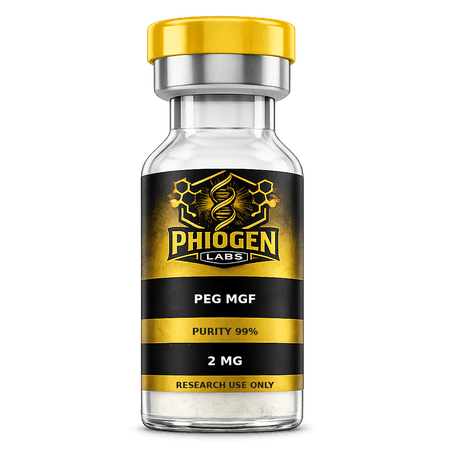
PEG-MGF 2mg
Research-grade PEG-MGF 2mg. 99% purity, third-party tested with published COA.
Ships from USA
1–3 day delivery
Free Shipping
On orders $150+
Peptide Handling & Storage Guide
Storage temperature, shelf life & reconstitution (PDF)
99%+ Purity
COA included
Same-Day Shipping
Orders before 2PM EST
Secure Checkout
SSL encrypted
Shipment Protection
Lost or damaged — reshipped free
Compound Information
- Type
- PEGylated mechano growth factor — IGF-1Ec E-domain peptide
- Molecular Formula
- C121H199N41O40
- Molecular Weight
- 2868.2 g/mol (unmodified MGF peptide)
- Purity
- 99%
- Sequence
- YQPPSTNKNTKSQRRKGSTFEERK (MGF reference sequence; PEG attachment site not established)
- Also known as
- Mechano growth factor, IGF-1Ec
Reference chemistry (free base) from public chemical databases and peer-reviewed literature. For laboratory research identification only.
Research Use Only. This vial is bound for the lab bench — supplied for in-vitro scientific work exclusively, never for administration to any person or animal.
About PEG-MGF
Mechano growth factor is not a separate gene product. It is a splice variant of the human IGF1 gene — IGF-1Ec (UniProt P05019-4) — and the peptide sold as MGF is the 24-residue C-terminal fragment of that variant’s E-domain propeptide, the portion cleaved away and discarded when IGF-1 matures. The reference human sequence is Tyr-Gln-Pro-Pro-Ser-Thr-Asn-Lys-Asn-Thr-Lys-Ser-Gln-Arg-Arg-Lys-Gly-Ser-Thr-Phe-Glu-Glu-Arg-Lys (YQPPSTNKNTKSQRRKGSTFEERK), as registered in UniProt, RefSeq NP_001104753.1, and the FDA substance registry under UNII Q86M4KXC2P. Worth knowing: material analyzed from circulation has repeatedly been found to differ from that reference. Analytical laboratories examining material obtained from circulation have characterized a C-terminally amidated analog (Esposito et al., Rapid Communications in Mass Spectrometry 2012, PMID 22328223) and an arginine-to-histidine substitution at position 23, designated MGF R23H (Cox et al., Drug Testing and Analysis 2017, PMID 28035768; see also Thevis et al., Growth Hormone & IGF Research 2014, PMID 25466910). "MGF" is therefore a name covering several distinct molecules rather than one defined substance.
On the PEGylation itself, the honest position is that almost nothing is published. A full-text search of the peer-reviewed literature returns no study characterizing PEG-MGF as a substance; public substance registries hold records for unmodified MGF and its C-terminal amide but none for a PEGylated form; and across three independent laboratories that analyzed real "MGF" products with high-resolution mass spectrometry, no PEGylated form was found or characterized. Consequently there is no published PEG chain length, no established attachment site, no confirmed mass, and no pharmacokinetic data of any kind. The general rationale for PEGylating a peptide — extending circulating half-life and slowing proteolysis and renal clearance — is well established for other molecules, but it has not been measured for this one, and a 2026 review notes explicitly that effects observed with native IGF-1Ec or isolated E-domain peptides cannot be assumed to carry over to PEG-conjugated constructs (PMID 42395176).
The research on unmodified MGF is in vitro and animal work. The E-domain variant was originally cloned from stretched rabbit muscle (Yang et al., Journal of Muscle Research and Cell Motility 1996, PMID 8884603), and a rat study reported that MGF messenger RNA rises rapidly after muscle damage and then falls as another isoform rises, a time course the authors interpreted as consistent with satellite-cell activation (Hill & Goldspink, Journal of Physiology 2003, PMID 12692175) — a temporal correlation rather than a causal demonstration. The synthetic 24-mer has been reported to increase myoblast proliferation while inhibiting terminal differentiation in cell culture (Yang & Goldspink, FEBS Letters 2002, PMID 12095637). Two caveats belong with all of this. The frequently repeated claim that the E-peptide acts independently of the IGF-1 receptor is contested rather than settled: it is supported by antibody-blockade and receptor-knockdown work (PMID 12095637; PMID 20844834) and directly rebutted by an independent laboratory whose paper is titled to that effect (Brisson & Barton, PLoS One 2012, PMID 23029120). And the endogenous free peptide has never actually been isolated from cells, tissue, or biological fluid — a point made in a 2010 review in Endocrinology (PMID 20130113) and conceded in a review co-authored by the originating group.
Neither MGF nor PEG-MGF is an approved drug. This product is supplied strictly for in vitro and laboratory research and is not for human or veterinary use.
Frequently Asked Questions
What is PEG-MGF?
PEG-MGF is a PEGylated form of mechano growth factor, a 24-amino-acid peptide corresponding to the C-terminal E-domain of the IGF-1Ec splice variant of the IGF1 gene. It is supplied for laboratory research use only and is not for human or veterinary use.
What is MGF (mechano growth factor)?
MGF is not a separate gene. It is a splice variant of the IGF1 gene, called IGF-1Ec in humans, and the peptide sold under the name is the 24-residue C-terminal fragment of that variant’s E-domain propeptide — the part removed and discarded when IGF-1 matures. The reference sequence is YQPPSTNKNTKSQRRKGSTFEERK.
Has PEG-MGF itself been studied in the peer-reviewed literature?
No. The published research is on unmodified MGF. A full-text literature search returns no study characterizing PEG-MGF as a substance, public substance registries hold no PEGylated MGF record, and three independent laboratories that analyzed "MGF" products by high-resolution mass spectrometry did not find or characterize a PEGylated form. There is no published PEG chain length, attachment site, confirmed mass, or pharmacokinetic data for it.
Is MGF the same as IGF-1 or IGF-1 LR3?
No, and the three are commonly confused. MGF contains none of the mature IGF-1 hormone — it comes from the propeptide that is cleaved off during IGF-1 maturation. IGF-1 LR3 is a different molecule again: the full 70-amino-acid mature IGF-1 with an arginine substitution and a 13-residue N-terminal extension. MGF shares no sequence with mature IGF-1. Note also that recombinant IGF-1 (mecasermin) is an approved medicine; MGF is not that molecule.
What does the research on MGF actually show?
It is in vitro and animal work. The variant was cloned from stretched rabbit muscle (PMID 8884603); a rat study reported that MGF messenger RNA rises quickly after muscle damage (PMID 12692175), a time correlation rather than a causal demonstration; and the synthetic peptide has been reported to increase myoblast proliferation in cell culture (PMID 12095637). Two important qualifications: the claim that it acts independently of the IGF-1 receptor is contested, with a direct published rebuttal from an independent laboratory (PMID 23029120), and the endogenous free peptide has never been isolated from any cell, tissue, or fluid (PMID 20130113).
Is PEG-MGF an approved drug?
No. Neither MGF nor PEG-MGF is an approved drug. The material supplied here is a research chemical intended for in vitro and laboratory use only and is not for human or veterinary use.
What forms of MGF exist?
Several distinct molecules circulate under the single name. Registry records exist for the native-sequence free acid and for a C-terminally amidated form. Analytical work on circulating material has additionally identified an arginine-to-histidine substitution at position 23 (MGF R23H) and a truncated full-length variant. "MGF" is also used for a 24-residue peptide, a 25-residue variant, and a much longer protein, so the name alone does not specify a molecule — identity should be established analytically.
Related Research Peptides
Research & References
Independent databases and peer-reviewed literature for PEG-MGF. Provided for research reference only.
External resources are independent and not affiliated with or endorsed by PHIOGEN. Listed for laboratory research reference only.