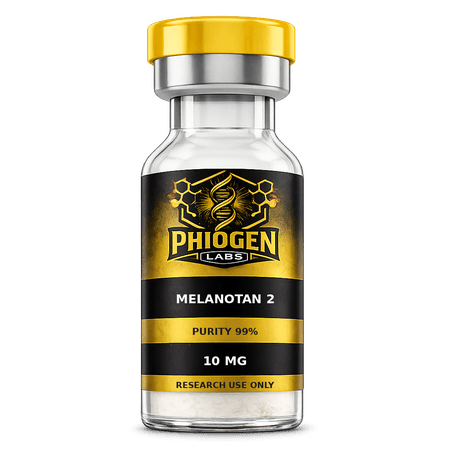
Melanotan II 10mg
Research-grade Melanotan II 10mg. 99% purity, third-party tested with published COA.
Ships from USA
1–3 day delivery
Free Shipping
On orders $150+
Peptide Handling & Storage Guide
Storage temperature, shelf life & reconstitution (PDF)
99%+ Purity
COA included
Same-Day Shipping
Orders before 2PM EST
Secure Checkout
SSL encrypted
Shipment Protection
Lost or damaged — reshipped free
Compound Information
- Type
- Cyclic lactam melanocortin receptor agonist (heptapeptide)
- Molecular Formula
- C50H69N15O9
- Molecular Weight
- 1024.2 g/mol
- CAS Number
- 121062-08-6
- Purity
- 99%
- Sequence
- Ac-Nle-cyclo[Asp-His-D-Phe-Arg-Trp-Lys]-NH2
- Also known as
- MT-II
Reference chemistry (free base) from public chemical databases and peer-reviewed literature. For laboratory research identification only.
Research Use Only. This vial is bound for the lab bench — supplied for in-vitro scientific work exclusively, never for administration to any person or animal.
About Melanotan II
Melanotan II is a cyclic seven-residue peptide, Ac-Nle-cyclo[Asp-His-D-Phe-Arg-Trp-Lys]-NH2, closed by a side-chain lactam bridge between the aspartate at position 2 and the lysine at position 7, with an acetylated N-terminus and an amidated C-terminus. Its molecular formula is C50H69N15O9 and its molecular weight approximately 1024.2 g/mol (CAS 121062-08-6, PubChem CID 92432). It was designed from the alpha-MSH 4-10 core by residue substitution and cyclization, the constraint being intended to lock the pharmacophore into an active conformation (Al-Obeidi et al., Journal of Medicinal Chemistry 1989, PMID 2535874). Pharmacologically it is a non-selective full agonist at MC1, MC3, MC4 and MC5, and is not a recognised ligand at MC2.
Nomenclature is worth pinning down, because several distinct designations circulate. "MT-II" is the registered short form; "MT-2" is not a registered synonym, and both MT-1 and MT-2 additionally collide with the standard nomenclature for the melatonin receptors, which are unrelated. Melanotan II has no international nonproprietary name, no United States Adopted Name, and no ATC code. Two database artifacts are also routinely misread as approvals and are not: bulk-ingredient entries in the National Drug Code directory, which are registrations rather than approved products, and "approved" status in the FDA substance registry, which refers to the curation state of a database record rather than to any regulatory approval.
Analytical work on material circulating under this name is directly relevant to its use as a reagent, and it is not reassuring. Published analyses of samples obtained from circulation have found unidentified impurities and vials underfilled relative to their stated contents (PMID 24771717), a sample assayed at roughly 30 percent purity (PMID 39302005), and falsified peptide products containing the wrong compound, the wrong quantity, or none of the stated compound at all (PMID 26456392, PMID 30165334). Identity and purity should be verified analytically rather than assumed from a label. Melanotan II is not an approved drug, and this product is supplied strictly for in vitro and laboratory research and is not for human or veterinary use.
Frequently Asked Questions
What is Melanotan 2?
Melanotan II is a synthetic cyclic seven-residue peptide, Ac-Nle-cyclo[Asp-His-D-Phe-Arg-Trp-Lys]-NH2, that acts as a non-selective full agonist at melanocortin receptors including MC1, MC3, MC4 and MC5. It is supplied here for laboratory research use only and is not for human or veterinary use.
What is the structure of Melanotan 2?
It is a cyclic heptapeptide closed by a side-chain lactam bridge between the aspartate at position 2 and the lysine at position 7, acetylated at the N-terminus and amidated at the C-terminus. Molecular formula C50H69N15O9, molecular weight approximately 1024.2 g/mol (CAS 121062-08-6, PubChem CID 92432). It was derived from the alpha-MSH 4-10 core by substitution and cyclization (PMID 2535874).
Is Melanotan 2 an approved drug?
No. Melanotan II is not an approved drug, and it has no international nonproprietary name, no United States Adopted Name and no ATC code. Bulk-ingredient entries in the National Drug Code directory and "approved" record status in the FDA substance registry are not approvals and should not be read as such. The material supplied here is a research chemical for in vitro and laboratory use only and is not for human or veterinary use.
What is the difference between Melanotan 1 and Melanotan 2?
They are structurally different molecules. Melanotan I, also called afamelanotide, is a linear 13-residue peptide; Melanotan II is a smaller cyclic 7-residue peptide closed by a lactam bridge between positions 2 and 7. Both are non-selective full agonists across melanocortin receptors, so the common claim that one is MC1-selective and the other is not is unsupported by the receptor data. Both are supplied here for laboratory research use only.
Is Melanotan 2 the same as PT-141 (bremelanotide)?
No, though they are closely related and are frequently conflated. Bremelanotide is structurally identical to Melanotan II except that the C-terminal amide is replaced by a free carboxylic acid — a deamidated analog. They are distinct compounds with distinct registry identifiers, and literature or regulatory status attaching to one does not describe the other. Both are supplied here for laboratory research use only.
How pure is material sold as Melanotan 2?
Published analytical work on samples circulating under this name has repeatedly found quality problems: unidentified impurities and vials underfilled relative to their stated contents (PMID 24771717), a sample assayed at roughly 30 percent purity (PMID 39302005), and falsified products containing the wrong compound, the wrong quantity, or none of the stated compound (PMID 26456392, PMID 30165334). Identity and purity should be verified analytically rather than assumed from a label.
Related Research Peptides
Research & References
Independent databases and peer-reviewed literature for Melanotan II. Provided for research reference only.
External resources are independent and not affiliated with or endorsed by PHIOGEN. Listed for laboratory research reference only.