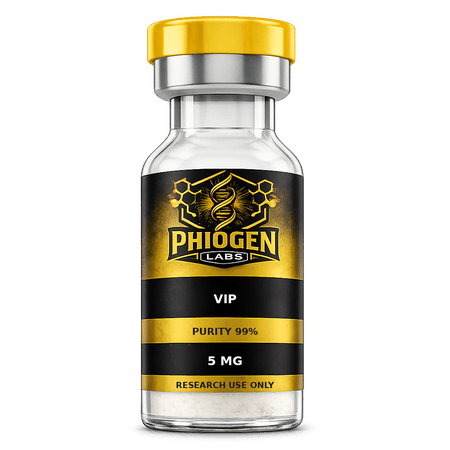
VIP 5mg
Research-grade VIP 5mg. 99% purity, third-party tested with published COA.
Ships from USA
1–3 day delivery
Free Shipping
On orders $150+
Peptide Handling & Storage Guide
Storage temperature, shelf life & reconstitution (PDF)
99%+ Purity
COA included
Same-Day Shipping
Orders before 2PM EST
Secure Checkout
SSL encrypted
Shipment Protection
Lost or damaged — reshipped free
Compound Information
- Type
- Vasoactive intestinal peptide (28-aa neuropeptide)
- Molecular Formula
- C147H238N44O42S
- Molecular Weight
- 3325.8 g/mol
- CAS Number
- 37221-79-7
- Purity
- 99%
- Sequence
- HSDAVFTDNYTRLRKQMAVKKYLNSILN-NH2
- Also known as
- Vasoactive intestinal polypeptide, Aviptadil
Reference chemistry (free base) from public chemical databases and peer-reviewed literature. For laboratory research identification only.
Research Use Only. This vial is bound for the lab bench — supplied for in-vitro scientific work exclusively, never for administration to any person or animal.
About VIP
Vasoactive intestinal peptide is a 28-residue, C-terminally amidated neuropeptide with the sequence His-Ser-Asp-Ala-Val-Phe-Thr-Asp-Asn-Tyr-Thr-Arg-Leu-Arg-Lys-Gln-Met-Ala-Val-Lys-Lys-Tyr-Leu-Asn-Ser-Ile-Leu-Asn-NH2 (HSDAVFTDNYTRLRKQMAVKKYLNSILN-NH2), encoded by the VIP gene on chromosome 6q25.2 (UniProt P01282). The C-terminal amide is not incidental — it is required for binding at this receptor class. VIP belongs to the secretin/glucagon/PACAP superfamily and shares roughly 68 percent homology with PACAP (Miyata et al., 1989, PMID 2803320), but the two are distinct peptides from distinct genes: VIP from VIP on chromosome 6, PACAP from ADCYAP1 on chromosome 18. The synthetic peptide carries the nonproprietary name aviptadil and is the identical 28-mer rather than an analog.
One identity caution is worth recording because it affects the numbers most sources print. PubChem and ChEMBL publish a free-acid molecular formula and mass against the amidated sequence, so the formula and mass in those records do not describe the native peptide — converting the C-terminus to the amide loses an oxygen and gains a nitrogen and a hydrogen. The amidated values are the correct ones. A separate PubChem record carrying D-tyrosine and allo-residues describes a stereochemically different molecule and should not be used for this compound.
The receptor pharmacology is well characterized. VIP acts at two class B G-protein-coupled receptors, VPAC1 (gene VIPR1) and VPAC2 (gene VIPR2), coupling primarily through Gs to adenylyl cyclase and cyclic AMP; its affinity at the related PAC1 receptor is several hundred-fold lower, so it behaves effectively as a VPAC1/VPAC2 dual agonist (Harmar et al., British Journal of Pharmacology 2012, PMID 22289055). Its documented physiological roles in animal models include smooth-muscle relaxation and vasodilation, stimulation of epithelial water and electrolyte secretion, and circadian signaling in the suprachiasmatic nucleus — the last supported by the strongest genetic evidence in the field, since mice lacking the VPAC2 receptor fail to sustain circadian rhythms (Harmar et al., Cell 2002, PMID 12086606), a phenotype echoed in VIP-deficient mice (Nature Neuroscience 2005, PMID 15750589).
A frequent misreading is worth heading off: the "VIP interneurons" of cortical neuroscience are cells identified by the fact that they express the VIP gene, and their signaling is GABAergic. That literature describes those cells, not the actions of the peptide as a reagent. As a practical matter for laboratory work, VIP is also extremely short-lived — an initial plasma half-life on the order of one to two minutes in published animal and ex vivo work — and is cleaved by mast-cell tryptase and by neprilysin. It is not a substrate for DPP-4, contrary to a common assumption: VIP carries serine at position 2, and that enzyme requires proline or alanine there (PMID 8100523). VIP is not an approved drug, and this product is supplied strictly for in vitro and laboratory research and is not for human or veterinary use.
Frequently Asked Questions
What is VIP peptide?
VIP, vasoactive intestinal peptide, is a 28-amino-acid endogenous neuropeptide (sequence HSDAVFTDNYTRLRKQMAVKKYLNSILN-NH2, UniProt P01282) that signals through the VPAC1 and VPAC2 receptors via cyclic AMP. It is used as a reagent in gastrointestinal, vascular, circadian and immunological research. It is supplied here for laboratory research use only and is not for human or veterinary use.
What receptors does VIP act on?
VIP acts at two class B G-protein-coupled receptors, VPAC1 (gene VIPR1) and VPAC2 (gene VIPR2), coupling primarily through Gs to adenylyl cyclase and cyclic AMP. Its affinity at the related PAC1 receptor is several hundred-fold lower, so it behaves effectively as a VPAC1/VPAC2 dual agonist (PMID 22289055).
What is the difference between VIP and PACAP?
They are distinct peptides from distinct genes — VIP from the VIP gene on chromosome 6q25.2, PACAP from ADCYAP1 on chromosome 18 — sharing roughly 68 percent homology (PMID 2803320). They are approximately equipotent at VPAC1 and VPAC2, but PACAP binds the PAC1 receptor several hundred-fold more strongly than VIP does. Related, not interchangeable.
Is VIP the same as aviptadil?
Yes. Aviptadil is the international nonproprietary name for synthetic VIP — the identical 28-amino-acid peptide, not an analog. Neither is an approved drug, and the material supplied here is a research chemical for in vitro and laboratory use only.
What is the molecular formula of VIP?
For the native amidated peptide, C147H238N44O42S at approximately 3325.8 g/mol. Note that PubChem and ChEMBL publish the free-acid formula (C147H237N43O43S, 3326.8) against an amidated sequence, so those records do not describe the native peptide — the C-terminal amide loses an oxygen and gains a nitrogen and a hydrogen relative to the free acid.
How stable is VIP?
It is very short-lived, with an initial plasma half-life on the order of one to two minutes in published animal and ex vivo work. It is cleaved by mast-cell tryptase and by neprilysin. It is not degraded by DPP-4, despite a common assumption to the contrary — VIP carries serine at position 2 and that enzyme requires proline or alanine at that position (PMID 8100523). Handling and storage should account for its rapid degradation.
Research & References
Independent databases and peer-reviewed literature for VIP. Provided for research reference only.
External resources are independent and not affiliated with or endorsed by PHIOGEN. Listed for laboratory research reference only.