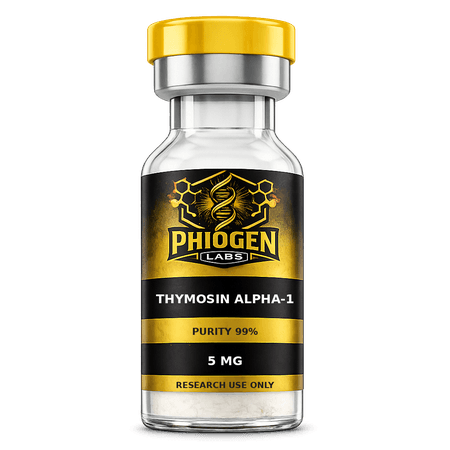
Thymosin Alpha-1 5mg
Research-grade Thymosin Alpha-1 5mg. 99% purity, third-party tested with published COA.
Ships from USA
1–3 day delivery
Free Shipping
On orders $150+
Peptide Handling & Storage Guide
Storage temperature, shelf life & reconstitution (PDF)
99%+ Purity
COA included
Same-Day Shipping
Orders before 2PM EST
Secure Checkout
SSL encrypted
Shipment Protection
Lost or damaged — reshipped free
Compound Information
- Type
- N-acetylated thymic immunomodulatory peptide (28-aa)
- Molecular Formula
- C129H215N33O55
- Molecular Weight
- 3108.3 g/mol
- CAS Number
- 62304-98-7
- Purity
- 99%
- Sequence
- Ac-SDAAVDTSSEITTKDLKEKKEVVEEAEN
- Also known as
- Thymalfasin
Reference chemistry (free base) from public chemical databases and peer-reviewed literature. For laboratory research identification only.
Research Use Only. This vial is bound for the lab bench — supplied for in-vitro scientific work exclusively, never for administration to any person or animal.
About Thymosin Alpha-1 (Thymalfasin)
Thymosin Alpha-1 is a 28-residue, N-terminally acetylated peptide with the sequence Ac-Ser-Asp-Ala-Ala-Val-Asp-Thr-Ser-Ser-Glu-Ile-Thr-Thr-Lys-Asp-Leu-Lys-Glu-Lys-Lys-Glu-Val-Val-Glu-Glu-Ala-Glu-Asn (Ac-SDAAVDTSSEITTKDLKEKKEVVEEAEN), molecular formula C129H215N33O55 and molecular weight approximately 3108.3 g/mol (CAS 62304-98-7, PubChem CID 16130571). It corresponds to the N-terminal portion of prothymosin alpha, the product of the PTMA gene (UniProt P06454), and is generated from it by cleavage at the asparagine-glycine bond at position 28 — work that settled a long-running question about whether the peptide was merely an artifact of thymus extraction (Sarandeses et al., Journal of Biological Chemistry 2003, PMID 12554742). It was originally isolated from calf thymus and sequenced in 1977 (PMID 265536). The synthetic form carries the nonproprietary name thymalfasin and is identical in sequence to the natural peptide.
The mechanistic literature centers on innate immune signaling rather than the older "thymic hormone" framing. In cell culture and mouse models, Thymosin Alpha-1 has been reported to drive functional maturation and interleukin-12 production in dendritic cells through MyD88-dependent Toll-like receptor signaling (Romani et al., Blood 2004, PMID 14982877), and later work from the same group describes induction of indoleamine 2,3-dioxygenase, associated with immune tolerance as well as activation. A nuance usually lost in summary: in cultured monocyte-derived dendritic cells the effect is bidirectional rather than uniformly stimulatory, enhancing responses to viral TLR3 and TLR7/8 agonists while sharply lowering the same parameters after bacterial TLR2 and TLR4 stimulation (PMID 26096650). Characterising this molecule as something that simply "boosts immunity" misrepresents the primary data.
The older description of Thymosin Alpha-1 as a thymic hormone that matures T cells is not well supported. A review of the field concluded that none of the isolated thymosin peptides is really a thymic hormone (PMID 12852257) — the framing is inherited from 1960s and 1970s work on crude thymus extracts rather than from characterization of this peptide. Published findings are laboratory observations in cell and animal models and do not establish any effect in humans. Thymosin Alpha-1 is not an approved drug, and this product is supplied strictly for in vitro and laboratory research and is not for human or veterinary use.
Frequently Asked Questions
What is Thymosin Alpha-1?
Thymosin Alpha-1 is a 28-amino-acid N-terminally acetylated peptide corresponding to the N-terminal portion of prothymosin alpha. Its synthetic form carries the nonproprietary name thymalfasin. It is used as a reagent in cell-culture and animal immunology research, and is supplied here for laboratory research use only — not for human or veterinary use.
What is the sequence of Thymosin Alpha-1?
It is the 28-residue N-terminally acetylated peptide Ac-SDAAVDTSSEITTKDLKEKKEVVEEAEN, molecular formula C129H215N33O55, molecular weight approximately 3108.3 g/mol (CAS 62304-98-7, PubChem CID 16130571). It corresponds to residues 2 to 29 of prothymosin alpha, the product of the PTMA gene (UniProt P06454).
Is Thymosin Alpha-1 the same as thymosin beta-4 or TB-500?
No — they are different molecules from different genes, and this is the most consequential confusion around the name. Thymosin alpha-1 is a 28-residue peptide from prothymosin alpha (gene PTMA). Thymosin beta-4 is a 43-residue actin-sequestering protein from a different gene (TMSB4X), with entirely different biology. TB-500, in turn, is usually not full thymosin beta-4 at all but a seven-residue fragment of it. Literature about one does not describe the others.
What is thymalfasin?
Thymalfasin is the nonproprietary name for the synthetic form of thymosin alpha-1 — the same molecule, not a different compound. Note also "Thymosin Fraction 5," which is not a peptide at all but a crude thymus extract containing many polypeptides, and from which thymosin alpha-1 was originally isolated; some older studies used the extract rather than the purified peptide, so results attributed to one may belong to the other.
What is the proposed mechanism of Thymosin Alpha-1?
The mechanistic research centers on innate immune signaling in cell culture and mouse models. It has been reported to promote dendritic cell maturation and interleukin-12 production through MyD88-dependent Toll-like receptor signaling (PMID 14982877), and to induce indoleamine 2,3-dioxygenase, associated with immune tolerance. The effect is not uniformly stimulatory: in cultured dendritic cells it enhanced responses to viral TLR agonists while sharply reducing responses after bacterial TLR2 and TLR4 stimulation (PMID 26096650). These are laboratory findings and do not establish any effect in humans.
Is Thymosin Alpha-1 an approved drug?
No. Thymosin Alpha-1 is not an approved drug, and the material supplied here is a research chemical intended for in vitro and laboratory use only. It is not for human or veterinary use and is not intended to diagnose, treat, cure, or prevent any disease.
Related Research Peptides
Research & References
Independent databases and peer-reviewed literature for Thymosin Alpha-1. Provided for research reference only.
External resources are independent and not affiliated with or endorsed by PHIOGEN. Listed for laboratory research reference only.