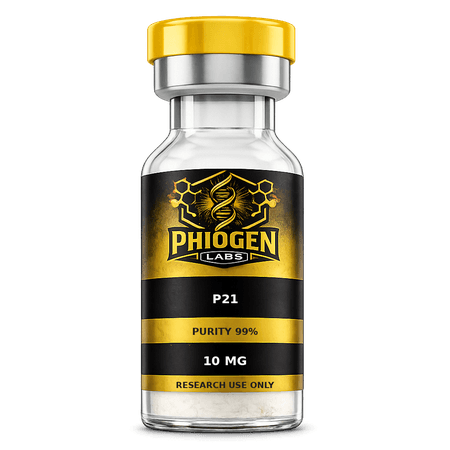
P21 10mg
Research-grade P21 10mg. 99% purity, third-party tested with published COA.
Ships from USA
1–3 day delivery
Free Shipping
On orders $150+
Peptide Handling & Storage Guide
Storage temperature, shelf life & reconstitution (PDF)
99%+ Purity
COA included
Same-Day Shipping
Orders before 2PM EST
Secure Checkout
SSL encrypted
Shipment Protection
Lost or damaged — reshipped free
Compound Information
- Type
- Adamantylated CNTF-derived neurogenic tetrapeptide
- Molecular Formula
- C27H42N6O8
- Molecular Weight
- 578.7 g/mol
- CAS Number
- 1246751-68-7
- Purity
- 99%
- Sequence
- Ac-Asp-Gly-Gly-Leu (Ac-DGGL) + 3-carbamoyl-1-adamantyl cap
- Also known as
- P021, Peptide 021
Reference chemistry (free base) from public chemical databases and peer-reviewed literature. For laboratory research identification only.
Research Use Only. This vial is bound for the lab bench — supplied for in-vitro scientific work exclusively, never for administration to any person or animal.
About P021
The compound sold under the name P21 is P021 (CAS 1246751-68-7; PubChem CID 56599151; FDA substance registry UNII VV8CZC8PAS), a synthetic peptidomimetic with the molecular formula C27H42N6O8 and an average molecular weight of about 578.7 g/mol. Structurally it is an adamantylated tetrapeptide: the four-residue sequence Asp-Gly-Gly-Leu (DGGL), corresponding to residues 148-151 of human ciliary neurotrophic factor, carrying an N-terminal acetyl group and a C-terminal amide bond to 3-amino-adamantane-1-carboxamide. The literature usually writes this shorthand as Ac-DGGLAG-NH2, which is a common source of confusion — the trailing "AG" denotes the adamantane cap, not alanine and glycine, so the molecule is a tetrapeptide rather than the six-residue peptide the shorthand appears to describe.
A separate and more important naming distinction: P21 in this catalog is not p21^Cip1/Waf1, the endogenous human cyclin-dependent kinase inhibitor encoded by the CDKN1A gene, nor is it p21^ras, the 21 kDa Ras protein. Those are naturally occurring proteins associated with cell-cycle arrest and with Ras signaling respectively, and the large literature on them describes entirely different molecules. Material published about cell-cycle arrest, p53, or tumor suppression under the name "p21" does not refer to this compound.
P021 originates from the laboratory of Khalid Iqbal at the New York State Institute for Basic Research in Developmental Disabilities, which derived it by epitope-mapping an earlier eleven-residue CNTF fragment ("Peptide 6") down to its active core and then acetylating and adamantylating that core; the design intent described in the associated patents (for example US 8,796,214 and US 9,327,011) was greater lipophilicity and resistance to peptidase breakdown. The mechanism proposed by that group involves competitive inhibition of leukemia inhibitory factor signaling and increased BDNF expression. That mechanism is the originating laboratory’s model, supported by their in vitro data rather than independently established.
The published evidence is entirely preclinical. Studies in mice and rats have reported effects on behavioural measures, hippocampal neurogenesis markers, and tau phosphorylation in transgenic and aged-rodent laboratory models (Kazim et al., Neurobiology of Disease 2014, PMID 25046994; Bolognin et al., Alzheimer’s Research & Therapy 2017, PMID 28655344; Kazim et al., Scientific Reports 2017, PMID 28368015; Bolognin et al., Neurobiology of Aging 2014, PMID 24702821). Two honest caveats belong alongside those results. First, every primary experimental study of P021 in the indexed literature includes the originating investigator as an author, so there is no fully independent replication; the one study led primarily by an outside laboratory in a new rodent model (Journal of Neurodevelopmental Disorders 2024, PMID 39592934) was largely negative on its in vivo endpoints. Second, although the adamantane modification was intended to aid brain penetration, how much P021 reaches the brain has not been directly measured, and sources conflict on whether penetration is established. P021 is not an approved drug, and this product is supplied strictly for in vitro and laboratory research and is not for human or veterinary use.
Frequently Asked Questions
What is P21 peptide?
P21 — more precisely P021 — is a synthetic adamantylated tetrapeptide built from residues 148-151 of ciliary neurotrophic factor (CNTF), with an N-terminal acetyl group and a C-terminal adamantane carboxamide. It has been used as a reagent in rodent and cell-culture neuroscience research. It is supplied for laboratory research use only and is not for human or veterinary use.
Is P21 peptide the same as the p21 protein (CDKN1A)?
No, and this is the most common confusion around the name. The p21 protein — p21^Cip1/Waf1, the product of the CDKN1A gene — is a naturally occurring cyclin-dependent kinase inhibitor involved in cell-cycle arrest and senescence. A third molecule, p21^ras, is the 21 kDa Ras protein. The research peptide P021 is a small synthetic CNTF-derived molecule unrelated to either. Literature about cell-cycle arrest, p53, or tumor suppression describes those proteins, not this compound.
What is the structure and sequence of P21?
P021 is an adamantylated tetrapeptide: acetyl-Asp-Gly-Gly-Leu joined at the C-terminus to 3-amino-adamantane-1-carboxamide. Its molecular formula is C27H42N6O8, average molecular weight approximately 578.7 g/mol (CAS 1246751-68-7, PubChem CID 56599151). It is often written Ac-DGGLAG-NH2, but the trailing "AG" in that shorthand refers to the adamantane cap rather than alanine and glycine, so the compound is a tetrapeptide.
What has P21 been studied for in research?
Published work is preclinical and confined to cell cultures and rodent models. Studies have reported effects on behavioural measures, markers of hippocampal neurogenesis, and tau phosphorylation in transgenic and aged-rodent laboratory models (PMID 25046994, PMID 28655344, PMID 28368015, PMID 24702821). These are observations in animal and cell models and do not establish any effect in humans.
How strong is the evidence base for P21?
It is narrow, and worth stating plainly. Every primary experimental study of P021 in the indexed literature includes the originating investigator as an author, so there is no fully independent replication, and the one study led primarily by an outside laboratory in a new rodent model (PMID 39592934) was largely negative on its in vivo endpoints. Most of the remaining work uses a single transgenic mouse line. Whether the compound reaches the brain has also not been directly measured, and sources disagree on that point.
Is P21 an approved drug?
No. P021 is not an approved drug, and the material supplied here is a research chemical intended for in vitro and laboratory use only. Note also that literature on full-length CNTF and other CNTF derivatives describes different molecules and is not data on this compound. It is not for human or veterinary use.
Related Research Peptides
Research & References
Independent databases and peer-reviewed literature for P21. Provided for research reference only.
External resources are independent and not affiliated with or endorsed by PHIOGEN. Listed for laboratory research reference only.